How to use Google Trends for keyword research
Google Trends is my favorite keyword research tool. In my opinion, the best thing about Google Trends is that it is free to use. In this guide, I’m going to show you how to use Google Trends to inform your SEO (search engine optimization) research.
The walkthrough and screenshot are from the original October 2023 article. Data definitions checked October 2026; the example has not been rerun in the current interface.
I use it regularly to find keywords that are trending. The tool helps me create content that is up-to-date and related to what people are searching for.
In my experience, the secret to good keyword research is understanding your customers’ latest needs and wants. The following step by step guide explains how to start using the tool.
Google trends keyword research in 5 steps
- Step 1: Visit https://trends.google.com (no login required)
- Step 2: Choose your location
- Step 3: Enter one or multiple keywords
- Step 4: Scroll down to related queries
- Step 5: Switch between “top” and “rising” to view suggested keywords.
Quick Tip 💡
Compare several relevant terms and inspect the related queries for each. The number of suggestions available depends on the query, filters and data; some terms have too little data to be useful.
The related queries section is where you will find keyword suggestions. All the keywords listed here are searched for by people on Google. You can click on any keyword to see its trend graph
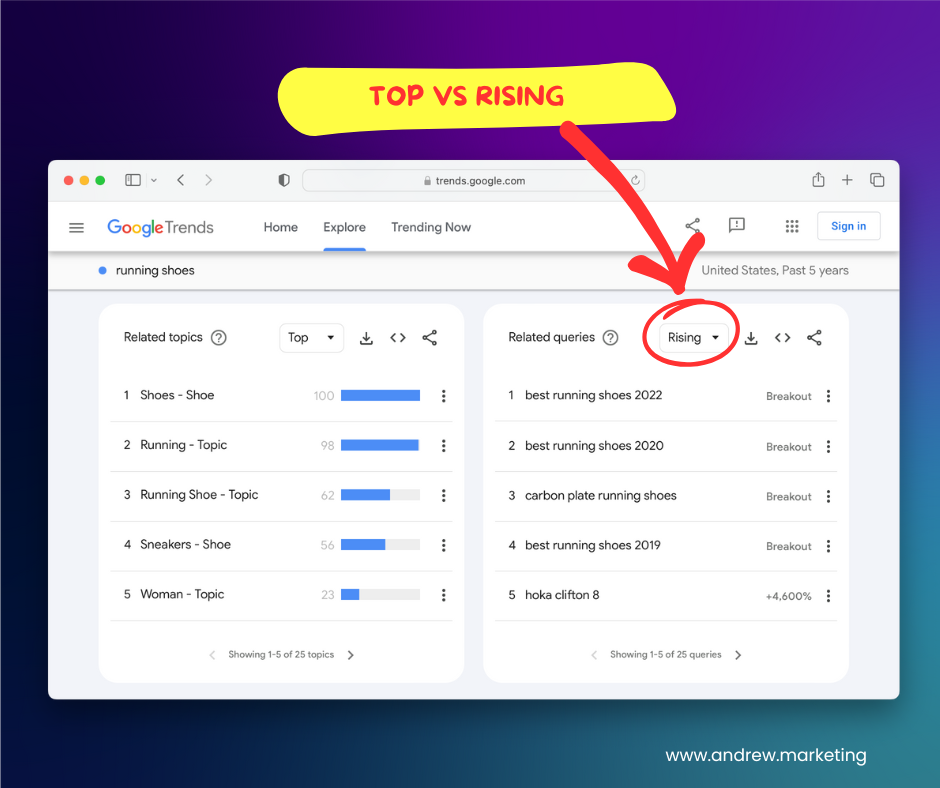
Historical screenshot from the October 2023 walkthrough; the interface and results may differ today.
I recommend going through both the Top and Rising lists for your selected term and filters.
Now it’s time to put your detective hat on. Look for common patterns between the keywords. Are there any words or topics that keep appearing? These are usually good themes to focus your content creation on.
What are Top Queries?
These are searches most frequently made with your term in the same search session, within the selected category, country or region. The index ranks their relative popularity in that context, with 100 marking the most popular related query; it is not an absolute search count. See Google's explanation of related searches.
What are Rising Queries?
These are related searches with the strongest growth in the selected period compared with the preceding period. The percentage next to a query shows that growth. Breakout means growth of more than 5,000%, according to Google's explanation.
A large percentage can start from a small baseline. Check the longer-term graph, the location and whether the query is relevant to your audience before treating it as a content opportunity. A Rising result is not an absolute search-volume figure or a promise of future demand.
|

Why is Google Trends good for SEO?
Google Trends can help you spot changes in search interest. This is useful for SEO research because it offers another way to investigate what your audience may be looking for.
A lot can change in a couple of months, products can go viral and consumer interests can turn on a dime.
Today a user might want to know “how to invest in bitcoin” and tomorrow they might want to know “how to invest in gold”.
It’s important that you are creating content around what people want to know about today rather than last year.
The data comes from Google, but it is still a sampled, normalized view of searches rather than a complete count or proof that a topic will perform well. Google's data FAQ explains how to interpret it. Use it alongside your audience knowledge and other evidence.
Does Google Trends show keyword search volume?
Google Trends Explore shows relative search interest, not an exact count of searches. Third-party Chrome extensions can add separate volume estimates alongside that view. Examples include:
Check the providers' current access terms, pricing, usage limits and data methodology before installing or subscribing. Their volume estimates are not Google's exact Trends counts and may use different time periods and methods.
You can also compare terms within the same location, period and search type to understand their relative search interest. Avoid treating those index values as exact numbers of searches or people.
Keyword research alternatives
Most marketers will use a mixture of tools when researching keywords. Google Trends is great to get trending insights but other tools offer extra metrics that will also help you with your research.
I recommend using multiple tools if you are serious about keyword research. The following list of tools are some of my favorites based on my personal experience.
- Ahrefs
- SEMrush
- Answer The Public
- Ubersuggest
These tools provide additional metrics, such as estimated search volume and their own keyword-competition scores. Those estimates can help you investigate a keyword, but the providers' scores are not interchangeable or a guarantee that you can rank for it.
It’s one thing to create content based on trending searches but there is little point creating it if you can’t get your content in front of people searching for it.
Finding good keywords takes some time. The aim is to choose questions you can answer usefully for your audience; keyword research alone does not guarantee improved rankings.
Next Steps
Try the five-step process for finding trending keywords for a worked historical example, including how to use autocomplete as a source of ideas rather than proof of growth.
For a broader introduction to interpreting the charts and using different search types, read how to use Google Trends. The original Glimpse review explains how I used an extension alongside Trends; check its current features and terms before choosing a plan.